

PGP’s process is designed to obtain gifts of Assets rather than Cash.


Why Does PGP’s Process benefit Your Organization?
Asset Gifts Feel Relatively Smaller
Where Donors’ Wealth is Held
1% - 3% Cash: (Checking, savings, money market deposit accounts, etc.)
97% - 99% Other financial assets: (stocks, bonds, mutual funds, life insurance, retirement accounts)
Cash Gifts naturally compare with our Disposable Income purchases (Small)
Asset Gifts naturally compare with our Wealth holdings (Large)
“For a wealthy donor, asking for the same gift from assets (where it constitutes a tiny share) rather than from income (where it constitutes a much larger share) may reduce the relative perception of financial loss.” 1
1. [Citation Displayed on Desktop Website] 1. James III, R. (2017). Natural philanthropy; a new evolutionary framework explaining diverse experimental results and informing fundraising practice. Palgrave Communications, 3, 17050, p. 4.3 2. 2. Wiepking, P., & Breeze, B. (2012). Feeling poor, acting stingy: The effect of money perceptions on charitable giving. International Journal of Nonprofit and Voluntary Sector Marketing, 17(1), 13-24. 3. Herzenstein, M., & Small, D. (2012). Donating in recessionary times: resource scarcity, social distance, and charitable giving. ACR, North American Advances.Asset Gifts Remind Donors of Their Wealth
People Who Feel Wealthy Act Charitably

The strongest predictor of donation amount was subjective feelings about one’s wealth, not its objective adequacy.
Market shoppers were asked Either…
What’s in your Wallet or Purse? Cash? Credit Cards?… or
Do you own Stocks? Bonds? CD’s?…
Those asked the Second question spent 36% more.
Relative comparisons change this feeling. Making college students feel richer by having them report their savings on a scale of $0 to $500, rather than $0 to $50,000, increased subsequent donations.
2. 3. 4. [Citations Displayed on Desktop Website]4. Morewedge, C.K., Holtzman, L., & Epley, N. (2007). Unfixed resources: Perceived costs, consumption, and the accessible account effect. Journal of Consumer Research, 34(4), 459-4674 Asset Gifts Mentally Reclassify Assets as Donation-Relevant
People attach labels to financial assets and then treat them differently.
When a donor makes a gift of a noncash asset, the donation experience can re-categorize that asset class as appropriate for future charitable donations.
For many, the first time they commit to a charitable gift from their wealth is when they add charity to their estate plan.
5. Thaler, R.H. (1999). Mental accounting matters. Journal of Behavioral Decision Making, 12(3), 1835. [Citation Displayed on Desktop Website]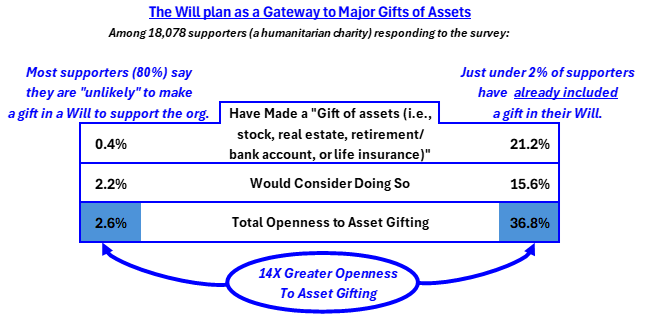
5Asset Gifts Reflect Donor-Centeredness
Action, Not Just Talk
Nonprofits promoting non-cash gifts are willing to increase their own hassle (cash is easier for the charity) to benefit the donor (gifts of appreciated assets are cheaper for the donor).
Irregular unearned Gains - like appreciated
assets - generate more giving
People are more likely to spend irregular unearned gains (vs. regular earned income) on luxury goods in general, & charitable donations in particular.
6. O'Curry, 1999Framing a donation as an exceptional event removes it from comparison with regular disposable income budget items and increases giving.
Asset Gifts Require Fundraiser Expertise
Organizations promoting and receiving non-cash gifts, especially complex gifts, are more likely to develop technically-skilled fundraisers. PGP focuses on keeping your Development team involved in planned giving activities so they can develop their technical skills.

7. Reinstein & Reiner, 2012; Konow, 2010 PGP’s advanced level of financial knowledge changes your donor relationship from "asking" to "advising", leading to enhanced long-term fundraising growth.
6. 7. 8. [Citations Displayed on Desktop Website]8. Sussman, Sharma, & Alter, 2015 86 710.Vohs, K. D., Mead, N. L., & Goode, M. R. (2008). Merely activating the concept of money changes personal and interpersonal behavior. Current Directions in Psychological Science, 17(3), 208-212. Savani, K., Mead, N. L., Stillman, T., & Vohs, K. D. (2016). No match for money: Even in intimate relationships and collectivistic cultures, reminders of money weaken sociomoral responses. Self and Identity, 15(3), 342-355.9. Mauss, M. (1923). Essai sur le don forme et raison de l'échange dans les sociétés archaïques. L’Année sociologique, 1, 30-186. [The Gift: Forms and Functions of Exchange in Archaic Societies ]; Cheal, D. (1987). Showing them you love them: gift giving and the dialectic of intimacy. Sociological Review, 35(1), 150-69.Gifts of Objects are Pro-Social
Gifts of objects are common in social relationships and emphasize communal norms rather than self-interested exchange relationships and exchange norms. 9

Cash is Anti-Social
Reminders of cash promote exchange motives, reducing willingness to help and to make donations. 10
9. 10. [Citations Displayed on Desktop Website]Appreciated Asset Gifts Are Objectively Cheaper
Donors Can Give More at the Same Net Cost
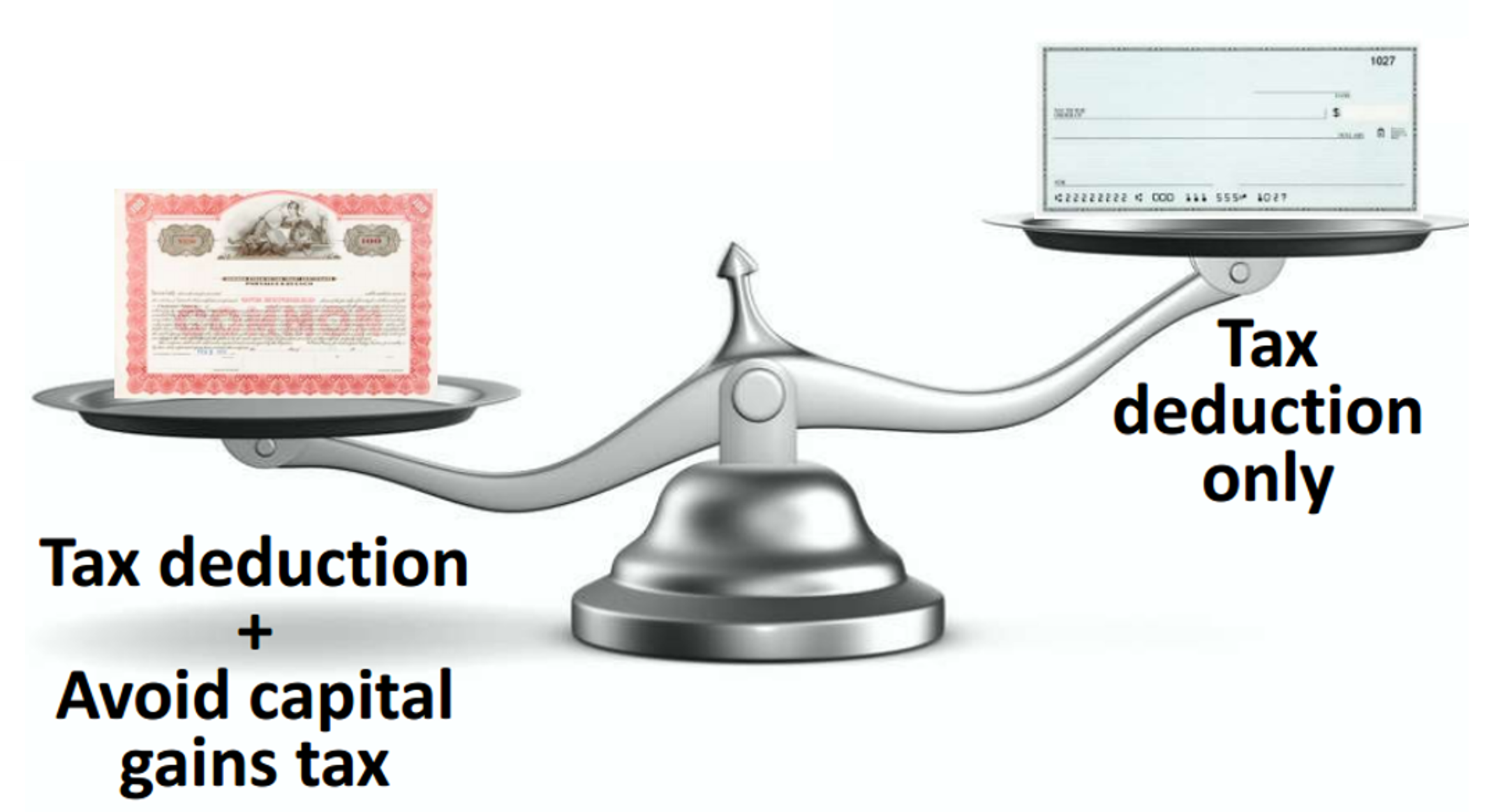
$100,000 Gift of Cash

Cost = $63,000
$100,000 Gift of Stock

Cost = $41,760
WHAT PEOPLE ARE SAYING…
“PGP’s process is seamless to our donors; in donor interactions, PGP introduces and presents themselves as the planned giving office of our organization, and in every respect to our donors, PGP is our staff Planned Giving Officer.”
- Paula, Nonprofit Executive Director“After months of struggling to comprehend my attorney’s estate recommendations, a conversation with your planned giving officer Steve really helped clarify how the tax benefits of major support of your mission can actually increase our family’s wealth. With our revised estate plan, we are supporting your lifesaving research now and into the future, bypassing estate expenses and taxes, and leaving our family more prosperous. Great for our family, great for your mission, bad for the IRS… a triple win in my book!”
- Daniel, Nonprofit Donor“Every interaction with PGP has been first-class; they are responsive, professional, true to their word, and are often considered for staff member of the month😉 They constantly focus on our priorities, our processes, our message, and orient all they do to be an integral member of our Development team.”
- Allison, Nonprofit Executive Director“By providing the ideation, structure and execution of our Legacy Society, Planned Giving Partners helped create a tangible and visible benefit to our cherished patrons, which is creating buzz and interest from other donors seeking inclusion in the Society.”
- Chris, Nonprofit Development Director